At some point in almost every conversation I have with a professional about publishing, a calculator comes out. Sometimes literally.
They are looking at a real investment, thousands of dollars, and their business brain does exactly what a good business brain should do. It runs unit economics. If a book earns a few dollars a copy, and the project costs what it costs, then I would need to sell, let me see, carry the two, an uncomfortable number of copies just to break even. And I can watch the enthusiasm drain away in real time.
I respect that instinct. I am the last person on earth who will tell you to ignore math. I built a publishing company on spreadsheets and print costs, and I put break-even numbers right on my service pages because I believe authors deserve to see them.
But if you are an established professional, running your book through consumer-product math is measuring the wrong thing entirely. It is like evaluating your website by asking how many people pay to visit it. Nobody pays to visit your website. Your website might still be the hardest working thing you own. The question was never how much does this asset earn per view. The question is what does this asset make possible.
Books work the same way. For professionals, the best ones almost always do.
Let me show you a photograph
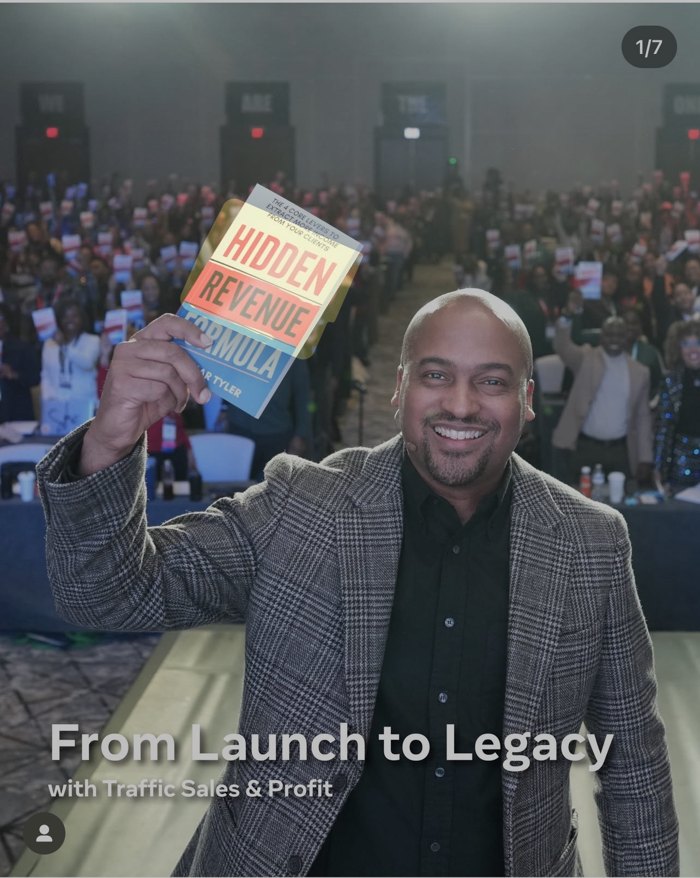
There is a picture I think about a lot. Lamar Tyler, founder of Traffic Sales and Profit, standing on a stage in front of a packed ballroom, holding his book Hidden Revenue Formula over his head while the entire crowd holds their copies up with him.
Look at that picture and ask yourself: is the interesting number here the royalty per copy?
Of course not. The interesting thing is everything around the book. That book is his methodology, in a form every person in that room takes home. It anchors his workshops. It travels into companies he has never visited and introduces his thinking to people he has never met. It shows up in the promo photos, the press, the bulk orders for the next event. In that photograph, the book is not really a product at all. It is infrastructure.
That is what I mean when I say the book does not have to be the business. The book can support the business. And for most professionals, that support is where nearly all of the value lives.
The part where I am honest with you
I run a publishing studio, which means everything I say on this subject comes with an obvious bias. So let me earn a little trust by telling you what a book will not do.
A book will not chase down clients for you. A book will not make strangers call you an authority just because your name is on a spine. A book with no plan behind it will not do anything at all, and I mean that plainly: there are plenty of professionally produced books sitting unnoticed on Amazon right now doing absolutely nothing for their authors. I have watched people spend real money on a book with no job assigned to it, and what they ended up owning was an expensive object in a garage.
The difference between a book that works and a book that gathers dust is almost never the writing. It is the integration. A book earns its keep when it is deliberately connected to the ecosystem you already have: your services, your programs, your patients, your stages, your audience. Give the book a job and it goes to work. Give it nothing and it sits there, exactly as unemployed as anything else without a job.
Which is why the planning conversation matters more than the printing.
What this looks like across professions
Picture a therapist who creates a guided journal that extends what they teach. They recommend it where clinically appropriate. They build a workshop around it. It sells on its own to people who will never book a session, and every copy is a quiet ambassador for how that therapist thinks. Whether or not the journal ever tops a chart, it is compounding for the practice in four directions at once.
Picture a consultant who publishes the framework behind his methodology. Prospective clients read it before the first call, which changes the first call. He walks in as the author of the playbook instead of one more vendor bidding for attention. Some of the most valuable things a book produces never appear on a royalty statement, and that one, walking into rooms pre-trusted, might be worth more than every retail sale combined.
Picture Jean Armand, whose Show Up Prepared health journal helps patients organize their medical history. Count its value in prepared patients, in reputation, in the way it distinguishes her in a field full of equally credentialed people. Then count the retail sales as the bonus they are.
Picture Dr. Erica Jordan-Thomas, whose 7-Figure Educator workbook lives inside her program as part of the client experience itself. That workbook is not competing on Amazon. It is doing delivery work, making her program more tangible and more finishable, which makes her program more valuable.
Different professions. Same pattern. In every case the book has a defined job, and unit sales sit somewhere between a side effect and a rounding error.
A better question than "how many copies"
So before you design a book, and definitely before you pay anybody to produce one, answer a different question first: what job do I want this book to perform in my professional world?
Maybe the job is reach, carrying your ideas to people you could never see one-to-one. Maybe it is education, so your clients or patients finally have the resource you keep wishing you could hand them. Maybe it is acquisition, a warm introduction that qualifies people before they ever contact you. Maybe it is delivery, a tool that lives inside a program or workshop you already sell. Maybe it is opportunity, the credential that strengthens every speaking pitch, media conversation, and partnership you pursue. And yes, maybe part of the job is revenue from the book itself. A good book holds several jobs at once. The best ones usually do.
But you have to assign the jobs on purpose. So here is the line I want you to carry out of this article, the one I find myself repeating in almost every strategy conversation:
Stop asking only "how much money will my book make?" Start asking "what can my book make possible?"
Full transparency, one last thing
Let me close with something that may sound surprising, coming from me. My own books did make the money. I have sold more than 750,000 copies. For years, my catalog was not supporting the business. My catalog was the business.
So why am I telling you the opposite? Because your situation is not mine. I publish children's books at volume for a broad retail audience. You have a practice, a firm, a program, a stage, an engine that already produces your income. For you, a book is not a lottery ticket to a new business. It is a lever attached to the business you already built. And levers are judged by one thing only: what they move.
Decide what you want moved. Then build the book for that job. That conversation, the job-of-the-book conversation, is where every project at my studio begins, and it is the reason strategic guidance is baked into every package instead of sold separately.
Wondering which format fits the job you have in mind? Read this next: From Expertise to Intellectual Property: 10 Things You Can Publish Besides a Traditional Book.