Let me tell you about a conversation I keep having.
Someone accomplished, a therapist with a full practice, a nurse practitioner with twenty years of charts behind them, a founder who built something real, mentions to me, almost apologetically, that they have always wanted to write a book someday. And then, in the very same breath, they talk themselves out of it. I would not even know what to write about. I am not really a writer. Maybe when things slow down.
Things never slow down. I have been publishing books for over a decade and I am still waiting for things to slow down.
But here is what a decade of doing this work has taught me, and I need you to sit with it: the people who say they would not know what to write about are almost always the people carrying the most material. They are just looking for their book in the wrong place. They are waiting for a Book Idea to strike like lightning, when the truth is that their book has been quietly assembling itself for years, one client conversation at a time.
You are not missing an idea. You are sitting on inventory you have never counted.
Where your book has been hiding
Think about your week. Your actual week, not the idealized one.
Somewhere in it, a client or a patient asked you a question you have answered a thousand times. You gave the explanation you always give, the one you have polished so thoroughly over the years that you could deliver it half asleep, with the same analogy you always reach for, because it works. Maybe you sketched the same little diagram on the same notepad. Maybe you assigned the same exercise, the same first step, the same reframe you have watched land a hundred times.
That explanation is content. That analogy is content. That exercise, that diagram, that sequence of first steps you have tested against real human beings and refined every single time it fell short, all of it is content. And it is better than anything a lightning bolt would have handed you, because you did not dream it up. You earned it through repetition. It is proven.
Same for the workshop you have given so many times you no longer need the slides. The intake process you built because the standard one kept missing what mattered. The framework you scribbled on a whiteboard once and have been using ever since. The opinion about your field that would make half your colleagues nod and the other half argue with you in the parking lot. And yes, the parts of your life that have nothing to do with your credential, the divorce, the diagnosis, the reinvention. Lived experience is expertise too. It is just the kind nobody hands you a certificate for.
So hear me: the work in front of you is not creating something. It is walking through what you already have, deciding what deserves to exist outside of you, and giving it a shape somebody can hold.
Let me tell you about Jean
Jean Armand is an advanced practice nurse. The letters behind her name go on for a while: MSN, AGACNP, FNP. And for years, she watched the same scene play out in front of her. Patients arriving at appointments unprepared. Medical histories scattered across three portals, two shoeboxes, and somebody's memory. Medication lists half remembered. The crucial question forgotten until the drive home.
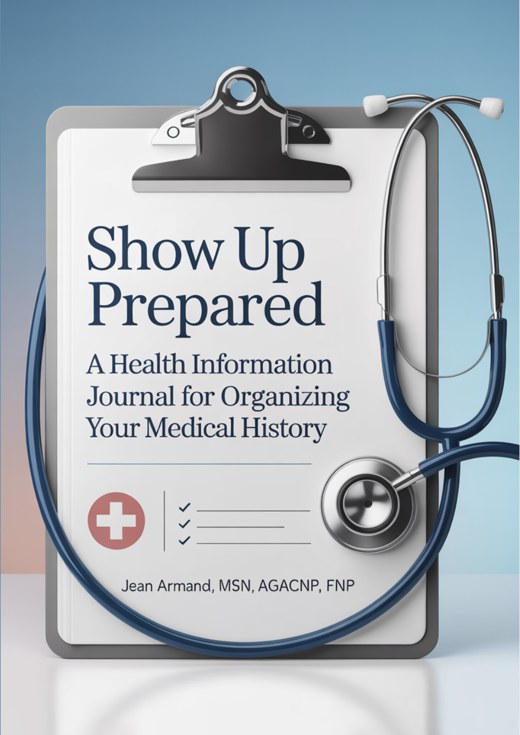
Now, Jean did not wake up one morning and announce she was becoming an author. What she had was closer to a low-grade professional frustration: this problem is fixable, and the tool that fixes it does not exist. So why does it not exist?
That question became Show Up Prepared, a health information journal that gives patients one organized place for their history, their medications, their questions. It is not a memoir. It is not two hundred pages of prose. It is a working tool, built from the exact knowledge Jean used every single day, and patients now carry it into real appointments.
I love Jean's story because it shows you the honest starting point of most professional publishing. It almost never begins with I want to write a book. It begins with this resource should exist, and apparently I am the one who has to make it.
If you have ever had that thought about anything in your field, do not let it float past you again. That thought is where books come from.
The path from what you know to what you publish
When I sit down with a professional, we walk a simple progression. Walk it with me now.
Start with the expertise. Not the book. The expertise. What do you know, teach, practice, or repeatedly help people accomplish? Cast the net wide. Your clinical knowledge counts. Your point of view counts. The thing you survived counts.
Find the idea inside it. Expertise is an ocean and a book is a glass of water. Which specific problem does your knowledge solve, for which specific person? A therapist does not publish everything they know about the human mind. A therapist publishes, say, the reflection practice that helps clients finally hear themselves think. Smaller than their expertise, and more useful because it is small.
Shape it into intellectual property. This is the step people skip, and it is the whole game. Knowledge in your head is not a product yet. It becomes one when it takes a structure somebody can move through without you in the room: a sequence, a framework, a set of prompts, a journey with a beginning and an end. When Kimberly Tyler-Brown, a licensed marriage and family therapist, created What's the Tea?, she was not pouring her clinical training onto pages. She was structuring the kind of guided reflection she facilitates professionally into a journey a stranger could take alone, with a beautiful cover on it.
And only then choose the format. Notice the format comes last. Most people start there, staring up at the intimidating mountain called A Book, when the right container for their knowledge might be a workbook, a guided journal, a patient resource, or a children's book. Monica Boddie, a licensed clinical social worker, carried deep knowledge about childhood trauma. The right shape for it was not a clinical text. It was Zayaquann's Story, a children's book that helps young readers move through grief, one she can use in a session and a grandmother can read on a couch.
Your book does not have to match your license
I want to sit on this point, because it releases more stuck professionals than anything else I say. Read this part twice.
Dr. Latasha Thomas is a Doctor of Physical Therapy and a board-certified neurologic clinical specialist. If you had asked me to guess her book, I would have guessed recovery, mobility, maybe stroke rehabilitation. Her actual book is called Worth More Than Rubies, and it is a guide to restoring your worth after divorce.
Her doctorate did not write that book. Her life did. But do not miss what the doctorate does: it tells you this is a woman of discipline and rigor, someone who finishes hard things, and that when she writes about rebuilding yourself, she is not being casual about it. The credential builds the trust. The experience supplies the book. They do not have to be about the same thing, and some of the best books I have ever helped publish came from that gap between what a person does for a living and what life has taught them.
So if the book stirring in you is not about your day job, that is not a problem to fix. That might just be your book.
An exercise, if you are willing
Block out twenty undistracted minutes and answer these honestly. I say this with respect, because I know exactly who I am talking to: these questions deserve more than a skim.
What do people repeatedly ask me for help with? What do I explain so often I could recite it from memory? What do I wish more people understood about my field? What process have I built that makes something genuinely easier? What do my clients or patients struggle with before they ever reach me? What transformation do I keep helping people make? Where do I disagree with the conventional wisdom in my profession? What did I learn the hard way that I wish somebody had handed me at the start?
And then the one I care about most: what resource do I keep wishing I could hand someone?
Watch what happens with that last question. You will not picture a manuscript. You will picture a thing, a journal, a guide, an organizer, a story, and you will feel a small jolt of certainty about exactly who needs it. Jean felt it about a health journal. Monica felt it about a grief story for children. Whatever you just pictured is not a daydream. It is a product waiting for a production team.
So, what do you know that deserves to exist outside of you?
You spent years, maybe decades, becoming the person who knows what you know. The knowledge is already there. The frameworks are already tested. The need is already sitting across from you at work every week, asking you the same questions.
The only thing missing is the object. And making the object, giving your knowledge a spine and a cover and a place on somebody's shelf, is the part you do not have to figure out alone. It is quite literally what my studio does all day.
Start with the page built for your work: Healthcare Professionals · Therapists and Mental Health Professionals · CEOs, Founders, and Experts