Think about the explanation you gave four times this week. The same condition, the same walkthrough, the same drawing on the back of the visit summary, delivered in the eleven minutes the schedule allowed, to a patient who will remember perhaps a third of it by the parking lot.
That gap, between what you know and what a patient can absorb in one visit, is where healthcare publishing lives. Not vanity projects. Working tools.
And instead of describing those tools in the abstract, let me show you how many of them live inside a single career. Meet Denise, a fictional nurse practitioner and certified diabetes educator, invented for this article as a composite. The real client books I name along the way are real. Here is what Denise could publish from the clinical knowledge she already uses every day.
Her appointment preparation resource
Denise's newly referred patients arrive scattered: histories across three portals, medication lists half remembered, the important question forgotten until the drive home. So her first product is Ready for Your Visit, a preparation journal that gives patients one organized place for their history, their medications, their numbers, and their questions. The appointment itself changes. The patient arrives oriented, and the visit spends its precious minutes on care instead of paperwork archaeology.
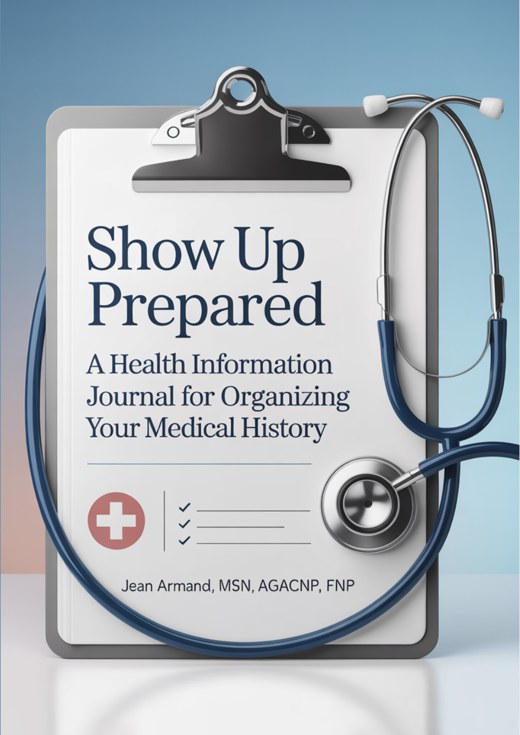
This is the category where the real proof lives. Jean Armand, MSN, AGACNP, FNP, a real client, publishes Show Up Prepared, a health information journal her patients carry into real appointments.
Her condition companion
Every new diagnosis in Denise's world creates the same scene: a stunned patient, a fifteen-minute explanation, then months of unsupervised Googling. So she writes Living With the New Numbers, a first-year companion for the newly diagnosed: what the numbers mean, what actually changes, which fears are outdated, what the next twelve months realistically look like. The companion does not practice medicine. It practices orientation, which is the thing no appointment has time for.
Her habit tracker
Denise knows the clinical truth that management lives in the daily log, and that patients abandon logging within three weeks when the tool is joyless. So she designs The Ninety-Day Reset Tracker, structured around exactly what she asks patients to record and exactly the encouragement she gives at follow-ups. Her clinical protocol, sitting on a kitchen counter, working daily.
Her caregiver guide
Half of Denise's real audience never sits on the exam table. It is the adult daughter managing a parent's condition from two states away. For her, Denise writes When Your Parent's Numbers Change: what to watch, what to stock, what to ask at appointments, when to worry. Caregivers are desperate for exactly this, and almost no one with real credentials is writing it for them.
Her children's book
Denise watches children watch their grandparents test their blood sugar, full of questions nobody quite answers. So she creates Grandpa's Sweet Blood, a picture book that explains the condition at a child's level and dissolves the fear around it. Children's health books are one of the richest categories in this field, and our studio's deepest specialty. The real-world proof that credentialed experts thrive here: Dr. Arlyne Simon, a PhD biomedical engineer, publishes the real Abby Invents series, turning STEM into stories children request by name.
Her authority book
And after twenty years in the system, Denise has something to say about the system itself. The Eleven-Minute Problem becomes her authority book: what chronic care cannot fit inside a visit, and what patients, families, and clinics can do about it. Books like this build speaking platforms, media presence, and a professional identity that outlasts any single role. If the manuscript is the barrier, our VIP Day format builds the book from a structured interview: you talk for a day, we craft the book from your own words.
Count them
One nurse practitioner. One clinical specialty. Six published products, every single one drawn from explanations Denise was already giving, protocols she was already assigning, and conversations she was already having. She did not become an author on top of her career. She published the career she already had.
The compliance paragraph, because precision matters in your world
Health-adjacent publishing carries obligations. Educational framing rather than medical advice. Clear disclaimers. Careful boundaries around diagnosis and treatment. None of that burdens a good book; it distinguishes one, and building that framing correctly is part of our production process on every health-related project. Your license taught you precision. Your book should demonstrate it.
Where to start
Do not start with "should I write a book." Start the way Denise would: with the explanation you repeat most, or the tool you keep wishing existed, and ask which format would carry it. The knowledge already does rounds with you. Publishing simply lets it keep working after you go home.
See how we work with clinical professionals: Publishing for Healthcare Professionals, or get your no-obligation quote.